Longevity & Healthspan Optimization in Beverly Hills

Our Approach to Longevity & Healthspan Optimization
Longevity and healthspan optimization focuses on preserving the cardiovascular health, metabolic function, physical capacity, cognitive sharpness, and overall vitality that allow you to remain active and independent as you age throughout your life. We take a physician-led, data-driven approach to identifying the factors that may influence how well you age and developing a strategy to improve them over time.
Our longevity and healthspan optimization program is an annual specialty program available to patients seeking a more comprehensive approach to preventive health. It is designed as an ongoing program rather than a one-time assessment, with a comprehensive annual evaluation followed by quarterly physician reviews to measure progress and refine the plan.
Dr. Omeed Warej is double board-certified in Internal Medicine and Cardiovascular Disease and completed his residency and cardiovascular fellowship at Cedars-Sinai Medical Center. He graduated summa cum laude from UC Berkeley and earned his medical degree from the David Geffen School of Medicine at UCLA. His background in internal medicine and subspecialty cardiology allows him to evaluate longevity through the interconnected systems that influence cardiovascular and metabolic health.
Our program brings together advanced testing and longitudinal physician oversight, including biological age testing, cardiopulmonary fitness assessment, advanced laboratory analysis, continuous glucose monitoring, body composition evaluation, and coordinated imaging. Rather than interpreting these measurements in isolation, Dr. Warej considers them alongside your medical history, family history, lifestyle, medications, and personal goals.
The objective is to establish a measurable baseline, identify areas where intervention may be valuable, and track meaningful changes over time. Your results are translated into a physician-authored longevity strategy with prioritized recommendations that can evolve as your health and goals change.
Should I Consider a Longevity & Healthspan Optimization Program?
You do not need to have a diagnosed disease or significant health concern to take a proactive approach to aging. A longevity-focused evaluation may be appropriate if you:
- Want to understand how your biological age compares with your chronological age
- Have a family history of cardiovascular disease, cancer, cognitive decline, or other age-related conditions
- Want objective measurements of your cardiovascular fitness and metabolic health
- Are interested in tracking VO2max and exercise capacity over time
- Have concerns about blood sugar, insulin resistance, cholesterol, inflammation, or metabolic health
- Want a more detailed evaluation of hormones, micronutrients, and other biomarkers
- Are interested in understanding how nutrition, exercise, sleep, and lifestyle affect your long-term health
- Want physician oversight of continuous glucose monitoring and other advanced health data
- Are looking for a structured strategy to preserve health and performance as you age
- Have completed a cardiovascular assessment and want continued monitoring and optimization
- Want an annual framework for measuring changes in your health rather than relying solely on routine physicals
A longevity program can be particularly useful if you are in your 40s, 50s, and 60s and are healthy today but want to identify opportunities for prevention before age-related changes become clinically significant.
What to Expect During a Longevity & Healthspan Optimization Program
The program combines advanced cardiovascular, metabolic, laboratory, imaging, and lifestyle assessments with ongoing physician review.
Your evaluation may include:
TruAge DNA methylation testing provides an epigenetic measure of biological age that can be tracked longitudinally.
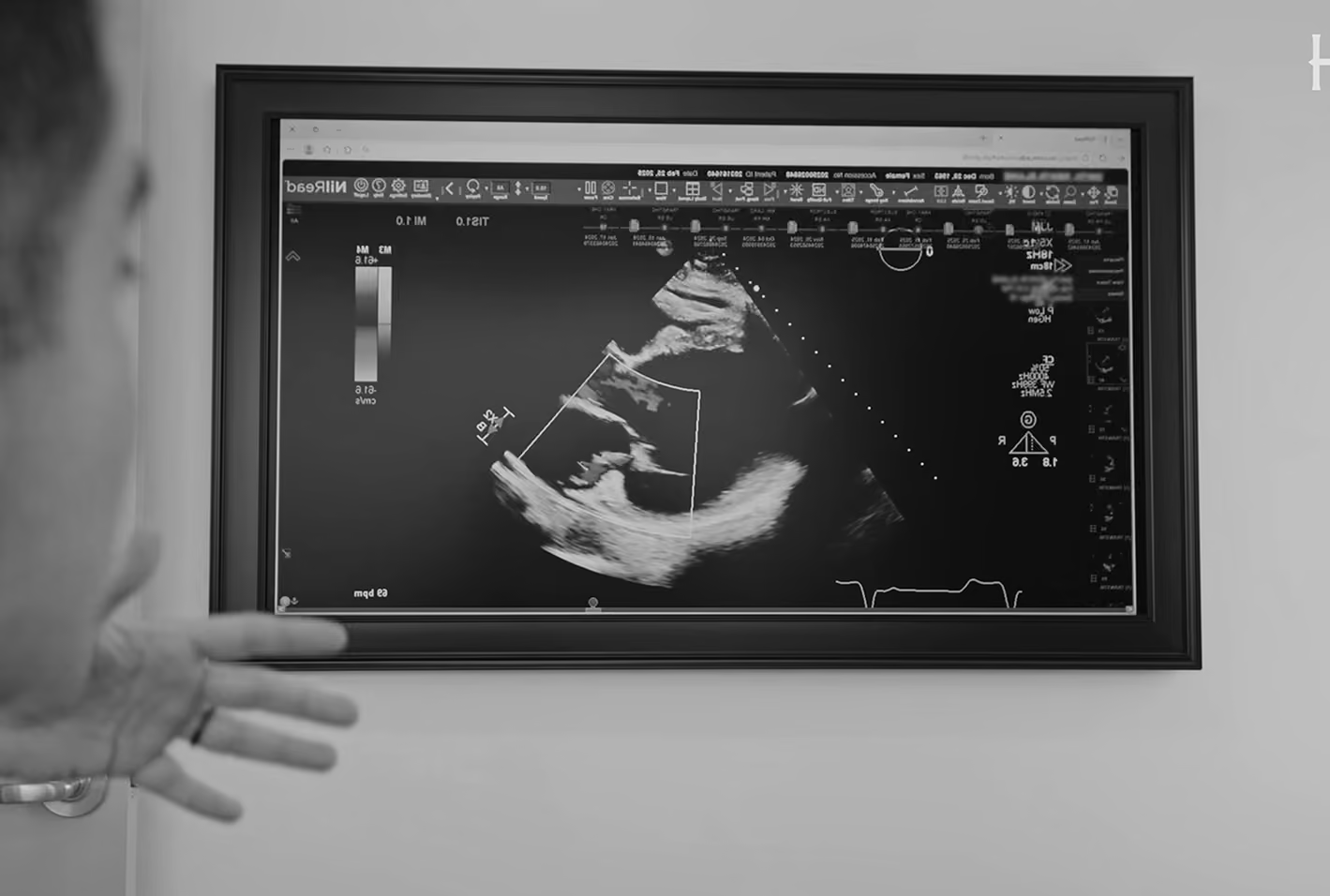
Resting EKG, echocardiography, CPET, and other cardiovascular testing provide information about cardiac structure, function, and exercise capacity.
Directly measures VO2max, anaerobic threshold, ventilatory efficiency, oxygen pulse, and other indicators of cardiopulmonary fitness.
CIMT and vascular ultrasound evaluate arterial health and provide additional information about vascular aging.
ApoB, Lp(a), LDL particle number, oxidized LDL, hs-CRP, and Lp-PLA2 provide a more detailed assessment of cardiovascular and inflammatory risk.
Testing may include testosterone, DHEA-S, IGF-1, cortisol, and expanded thyroid markers based on your individual needs.
Vitamin D, B12, magnesium, zinc, folate, omega-3 index, and other nutritional markers may help identify areas for targeted intervention.
Physician-supervised CGM can evaluate glucose variability, fasting patterns, post-meal responses, and exercise-related glucose changes over a defined period.
When appropriate, whole-body MRI can be coordinated through a contracted imaging partner and reviewed in the context of your broader health profile.
Thyroid and abdominal ultrasound may provide additional information about relevant organs and structures based on age and individual risk.
Bioelectrical impedance provides longitudinal data about body composition that can be considered alongside nutrition, exercise, and metabolic findings.
An in-home sleep study may be incorporated when sleep-disordered breathing or other sleep concerns warrant further evaluation.
Nutrition, exercise, sleep, stress, hydration, and recovery are considered alongside objective testing to create practical recommendations.
Dr. Warej integrates your findings into a comprehensive report with prioritized recommendations.
Three additional deep-review visits throughout the year provide opportunities to assess progress, review new data, and refine your strategy.
The program can also incorporate additional testing, including genetic screening, coronary calcium scoring, coronary CT angiography, extended cardiac monitoring, and precision nutrition testing when clinically appropriate.
FAQs About Longevity & Healthspan Optimization
What does a longevity program actually measure, and how is it different from an annual physical?
A traditional annual physical is important for preventive healthcare, but its scope is generally limited to routine history-taking, examination, screening, and laboratory testing. A comprehensive longevity program in Beverly Hills can go considerably deeper by establishing longitudinal measurements of cardiovascular fitness, vascular health, metabolic function, biological age, body composition, and other biomarkers. The key distinction is that the information is evaluated as a connected picture and revisited throughout the year rather than collected once and filed away until the next physical.
Is longevity and functional medicine evidence-based, or is it mainly focused on supplements and anti-aging treatments?
A physician-led longevity strategy should begin with established preventive medicine, risk assessment, and evidence-based interventions rather than assuming that supplements or unproven anti-aging treatments are appropriate. Our advanced testing is used selectively and interpreted within the context of your medical history, cardiovascular risk, medications, and lifestyle. Recommendations may involve nutrition, exercise, sleep, metabolic health, medication management, or supplementation when appropriate.
Should I have a cardiovascular longevity assessment before starting a broader longevity program?
Not necessarily. The appropriate starting point depends on your age, medical history, cardiovascular risk factors, goals, and previous testing. A cardiovascular longevity assessment in Beverly Hills can provide a particularly detailed baseline of cardiac, vascular, and exercise health, while our longevity and healthspan optimization program incorporates cardiovascular evaluation into a broader annual strategy that also addresses biological age, metabolic health, laboratory markers, nutrition, sleep, and other factors.
How often should I repeat advanced longevity testing?
The appropriate interval depends on the test. Some measurements are most useful when repeated annually or at longer intervals, while others, such as CGM data, may be collected for shorter periods and repeated when there is a clinical reason to reassess. Quarterly physician reviews allow Dr. Warej to determine which measurements are worth repeating and which changes are more meaningful when tracked over time.
Can a longevity program help if my routine bloodwork is normal?
Yes. Normal routine laboratory results do not necessarily provide a complete picture of cardiovascular fitness, vascular health, body composition, glucose variability, biological aging, or exercise physiology. A broader evaluation may identify opportunities for improvement even when conventional screening appears reassuring. The goal is to establish useful measurements rather than assume that every abnormality requires treatment.
How does Dr. Warej approach longevity differently from just a primary care physician or just a cardiologist?
Dr. Warej brings both perspectives to the same clinical relationship. As a double board-certified internist and cardiologist, he can integrate routine preventive and primary care with subspecialty cardiovascular assessment. His approach emphasizes measurable risk, early prevention, and longitudinal tracking while considering the broader factors that influence healthspan, including metabolic health, exercise, nutrition, sleep, and lifestyle.